


How Resistance, Temperature, and Charging Behaviors Impact Battery SOC and SOH


Get valuable resources straight to your inbox - sent out once per month
We value your privacy
Introduction
Battery state-of-charge (SOC) and state-of-health (SOH) are crucial factors that must be estimated to determine a battery’s available capacity and how well it performs compared to when it was new. This is especially important in applications such as e-scooters, where a battery suddenly shutting down or experiencing a failure could result in an accident.
This article will introduce battery SOC and SOH and discuss three factors that can impact SOC and SOH: internal resistance, temperature, and charge/discharge behavior. It will also explore MPS’s fuel gauges and battery protector and monitor solutions, which can work together to provide a complete BMS solution and provide highly accurate SOC and SOH estimates to prevent unexpected failures.
Battery State-of-Charge (SOC)
The battery’s SOC measures how much capacity is available relative to its full charge capacity. SOC is a percentage and helps users determine when the battery needs to be charged.
SOC ranges from 0% (a complete discharge) to 100% (a full charge). If a battery has an SOC of 20%, this means that the battery has about 20% of its charge left, and it is 80% discharged.
It is vital to be able to accurately estimate the SOC to ensure safe and reliable operation, especially in applications that require additional safety measures (e.g. high-voltage energy storage and e-bikes). Estimating the SOC can be accomplished by measuring the voltage, current and/or temperature, depending on the method used. MPS’s mixed-mode algorithm will be discussed later in this article.
Related Content
-
ARTICLE
Optimizing State-of-Charge (SOC) Accuracy and Battery Management System Design
This article explores the impact of both factors on the final SOC estimation accuracy to establish design practices that will allow designers to better allocate resources when trying to optimize for SOC accuracy and cost.
-
VIDEO
How to Accurately Measure Battery Pack SOC
Fuel gauges in battery-powered devices monitor the state-of-charge (SOC), a vital parameter for managing the device's battery pack comprised of multiple cells with varying conditions.
-
ARTICLE
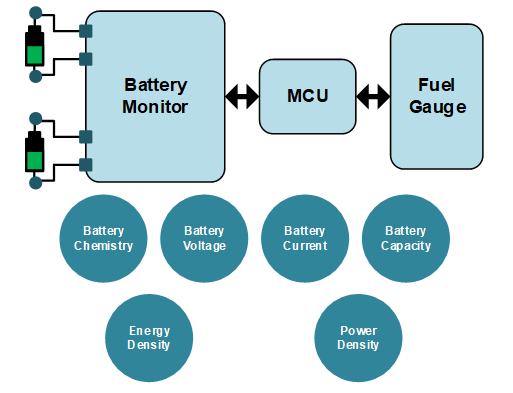
How Battery Characteristics Impact Battery Management
This article will provide a brief overview of some of the key physical and electrical characteristics of battery cells that affect their performance, behavior, limitations, and application uses.
-
PRODUCT
MBM16S-P50-x
The MBM16S-P50-x is a solution module for managing 7-cell to 16-cell series Li-ion battery packs.
Battery State-of-Health (SOH)
The battery’s SOH indicates how well the battery is performing compared to when it was new, which allows users to assess the battery’s function over time and determine when it should be replaced. Like SOC, SOH is represented as a percentage. 100% indicates that the battery can store its nominal capacity, while a lower percentage indicates that the battery has aged and can store less charge than the rated capacity.
Factors that Impact SOC and SOH
The next few sections of this article will focus on some key factors that can impact a battery’s SOC and SOH, though there are many other factors that can impact either SOC, SOH, or both.
Internal Resistance
Internal resistance impacts a battery’s performance by leading to energy loss, increased heat dissipation, and high voltage sags, which reduce the battery’s overall available capacity over time. A higher internal resistance typically results in lower power capabilities and faster SOH degradation.
Every battery has an internal resistance, which causes a voltage drop between battery terminals as current flows through the battery. A higher internal resistance results in reduced battery performance and lifespan over time; this, designers are encouraged to minimize internal resistance by using high-quality materials and optimizing battery structure.
Due to the relationship between voltage, current, and resistance, a higher resistance results in a larger voltage drop, which means the battery may reach its voltage limits, and there is less available energy for the receiving device. A higher internal resistance also generates more heat, which may negatively affect battery performance and lifespan. This increased heat generation reduces battery efficiency in the short term and long term.
Operating Temperature
Temperature impacts battery performance in a myriad of ways, which means it is vital to properly store and use batteries so that they do not operate at exceedingly low or high temperatures. At lower temperatures, battery performance degrades due to increased resistance and a subsequent reduction of available capacity. In addition, charging batteries at lower temperatures can cause lithium plating, which reduces battery capacity and can even result in an internal short-circuit condition. However, cooler temperatures can be beneficial for stored (or unused) batteries since it slows down other degradation mechanisms.
At higher temperatures, battery performance improves since the internal resistance is lower, which results in a lower voltage drop and maximizes the battery’s available capacity. However, batteries age much more quickly at higher temperatures. In addition, high temperatures can potentially damage the battery, create fires, and even lead to explosions, depending on the battery.
Temperature-dependent dynamics (e.g. open-circuit voltage and impedance) must be considered when estimating a battery’s SOC, or the estimated results may be inaccurate. This could result in a poor user experience or incorrect operation.
Table 1 shows the different tradeoffs regarding battery temperature.
Table 1: Temperature Tradeoffs
| Higher Temperature | Lower Temperature |
| Lower internal resistance | Higher internal resistance |
| Reduced voltage drop | Increased voltage drop |
| Higher available capacity | Reduced available capacity |
| Accelerated self-discharge | Slower self-discharge |
| Faster degradation | Risk of lithium plating |
Many devices that use batteries, including e-bikes and medical equipment, require accurate SOC and SOH estimation across a wide range of operating temperatures during the complete battery lifespan. Otherwise, end customers may experience battery early shutdown, accelerated degradation, and poor performance.
Overall battery performance can be improved by including fuel gauges such as the MPF42791 in the battery management system (BMS). This device incorporates a temperature-dependent, high-fidelity mathematical model that provides excellent accuracy, and it can estimate battery resistance and capacity to track aging and maintain accuracy across the battery’s lifespan.
Discharging, Charging, and Self-Discharge
Batteries can be charged and discharged, and the rates at which these occur impact SOC and SOH. For example, if a battery is overcharged or deeply discharged, this can permanently lower the battery’s overall capacity.
Many battery chargers, such as the MP2703 and MP2710, can be used to ensure that a battery safely discharges and charges within its safe limits, though a monitoring and protection device can offer additional protections that will be discussed later.
A battery’s self-discharge rate refers to how a battery loses charge and energy over time, even when the battery is idle or disconnected from a power source. This is a natural phenomenon that varies with battery chemistry and temperature, with rechargeable batteries (e.g. Li-ion and NiMH) discharging much more quickly than non-rechargeable batteries (e.g. alkaline).
Over time, batteries’ capacity reduces, which means self-discharge becomes more important because the battery is no longer able to store as much charge. In addition, ambient temperature can also affect a battery’s self-discharge rate. Because higher temperatures can cause batteries to self-discharge more quickly, it is recommended to store batteries at cooler ambient temperatures.
Using Fuel Gauges and Battery Monitors to Improve SOC and SOH
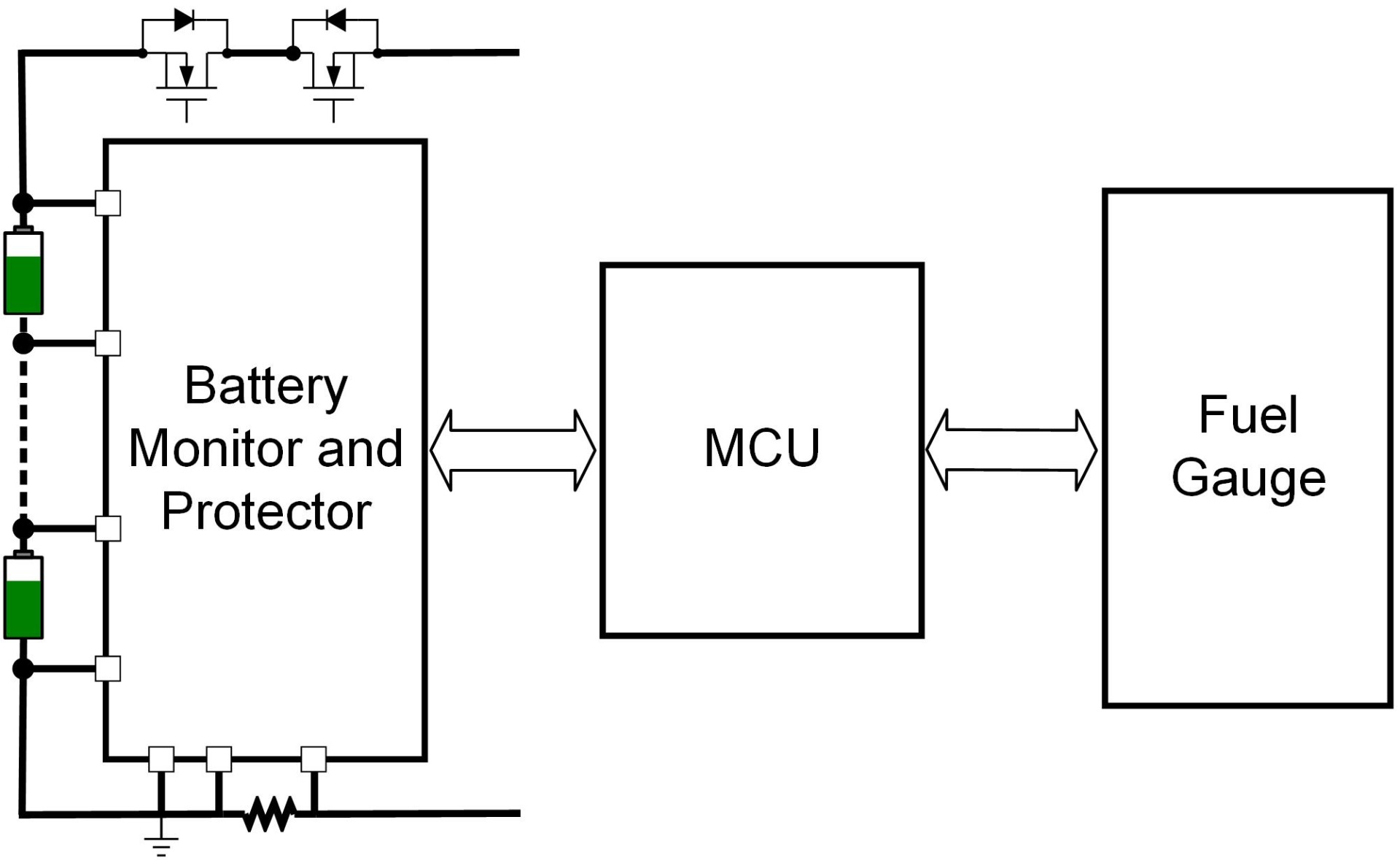
In addition to its battery chargers that provide safe and reliable operation, MPS offers both fuel gauges and battery monitor and protectors for a complete BMS solution (see Figure 1).

Figure 1: A Battery Management System
Fuel gauges provide accurate estimations for the battery’s SOC and other key insights about the battery operation, while battery monitors can quickly detect abnormal conditions and protect the system. Fuel gauges and monitors can work together to monitor critical battery parameters and provide protection.
MPS's Fuel Gauges
MPS’s MPF4279x family of fuel gauges use a highly effective mixed-mode algorithm to achieve excellent SOC estimation accuracy (see Figure 2).
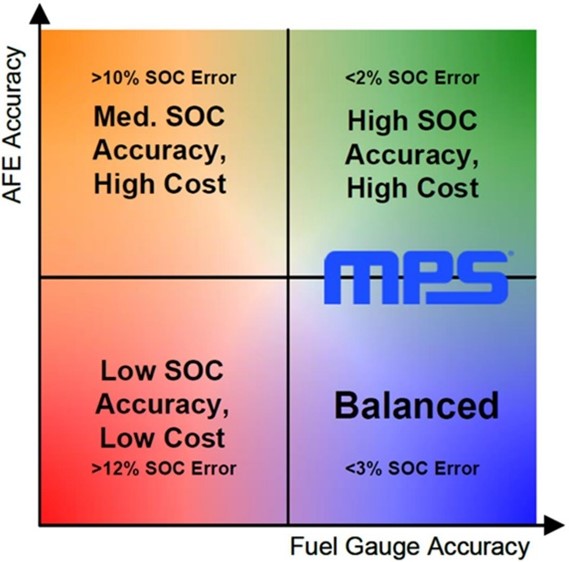
Figure 2: SOC Estimation
The MPF42791 fuel gauge provides comprehensive information on lithium-ion (Li-ion) battery strings for up to 16 cells in series. It supports a variety of cell chemistries and cell sizes that can be quickly configured, with optional adjustments for further fine-tuning.
This fuel gauge can estimate both the SOC and SOH for individual cells and the battery pack, while providing individualized data to quickly determine which cell in the overall pack is experiencing a fault condition. In addition, its onboard memory logs key parameters to gather historical data across the battery’s lifecycle. When the MPF4271 is paired with one of MPS’s battery monitors, it can achieve SOC accuracy to within 2.5%. Figure 3 shows the performance of the MP2796 and MPF42791 for the CC/CV charge and dynamic discharge cycle at an ambient temperature of 25°C.
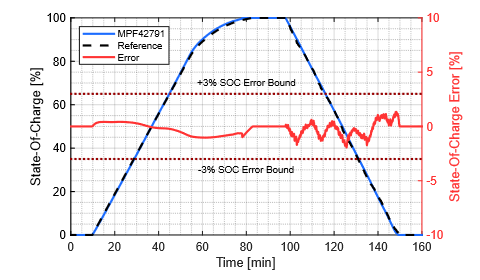
Figure 3: Combined MP2796 + MPF42791 Performance for a CC/CV Charge and Dynamic Discharge (Ambient Temperature = 25°C)
The I2C interface provides robust communication and can return real-time status information, such as individual cell SOC and SOH, power limits, remaining runtime, and charge time. The MPF42791 can drive five external LEDs that report the overall pack SOC. The LEDs can be set to direct control, where the MPF42791 directly controls the LEDs based on the pack SOC, or manual control, which allows the host to manually control each LED via the relevant register.
The MPF42793 is identical to the MPF42791, but is optimized for lithium-iron phosphate (LFP) battery packs. MPS also provides fuel gauges for up to 10 cells in series with LED indication (MPF42795) and fuel gauges up to 16 cells that do not have LED indication (MPF42792).
MPS's Battery Monitors and Protectors
An ideal BMS solution should be able to guarantee safe operation while prolonging the battery’s usable lifespan. MPS’s protectors can meet the safety and power demands for up to 16 cells in series while offering precise voltage, current, and temperature monitoring through analog-to-digital converters (ADCs).
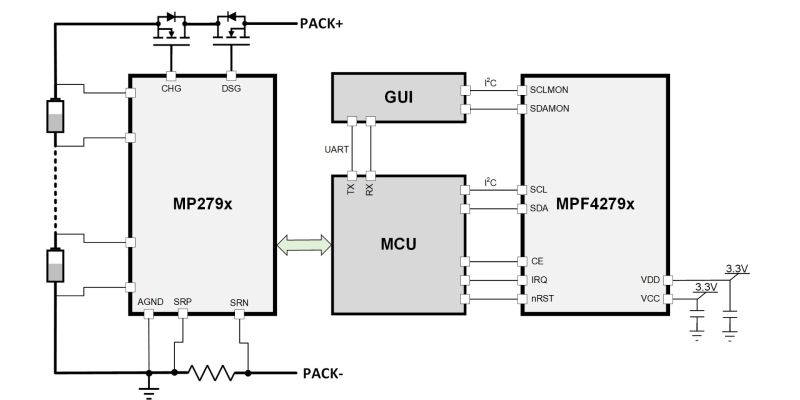
The MP2796 is a battery management device that provides a complete analog front-end (AFE) monitoring and protection solution. It supports connections for 7-cell to 16-cell series battery packs, and integrates two ADCs in a tiny TQFP-48 (7mmx7mm) package (see Figure 4). The first ADC measures the differential cell voltages between each cell (up to 16 cells), die temperature, and 4-channel temperatures from via the external NTC thermistors. The second ADC measures the charge/discharge current, and an integrated high-side MOSFET (HS-FET) controls the charge and discharge.
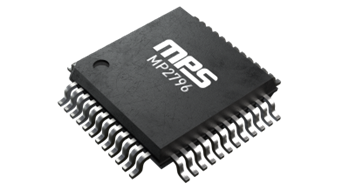
Figure 4: The MP2796
Internal passive balancing MOSFETs can be used to equalize mismatched cells to further extend the battery’s lifespan by ensuring no battery cell is forced to compensate for another cell experiencing a fault condition.
The MP2790, MP2791, and MP2797 are battery monitor and protectors supporting up to 10, 14, and 16 series cells, respectively. They also provide Coulomb counting, which keeps track of the charge going in and out of the battery.
Conclusion
It is important to monitor the battery’s SOC and SOH to achieve excellent performance and accurately determine battery’s age so that the overall application does not experience a power failure. This article discussed three key factors — internal resistance, temperature, and charge/discharge behavior — that can affect the SOC and SOH over time.
Devices like the MPF42791 and MP2797 enhance the BMS by providing accurate SOC and SOH estimations that can protect the battery and BMS from dangerous conditions and extend battery life. Explore MPS’s full portfolio of efficient fuel gauges and battery protectors and monitors to complete your BMS.
_______________________
Did you find this interesting? Get valuable resources straight to your inbox - sent out once per month!
Technical Forum
 Latest activity 6 days ago
 4 Comments
Latest activity 2 weeks ago
3 Comments
Latest activity 3 weeks ago
1 Comment
4 Comments
Latest activity 2 weeks ago
3 Comments
Latest activity 3 weeks ago
1 Comment
Log in to your account
Create New Account