


Optimizing State-of-Charge (SOC) Accuracy and Battery Management System Design


Get valuable resources straight to your inbox - sent out once per month
We value your privacy
Introduction
A battery management system (BMS) is made up of a series of electronic devices that monitor and control a battery’s operation. The main elements of a typical BMS are the battery monitor and protector, the fuel gauge, and the main microcontroller (MCU) (see Figure 1).
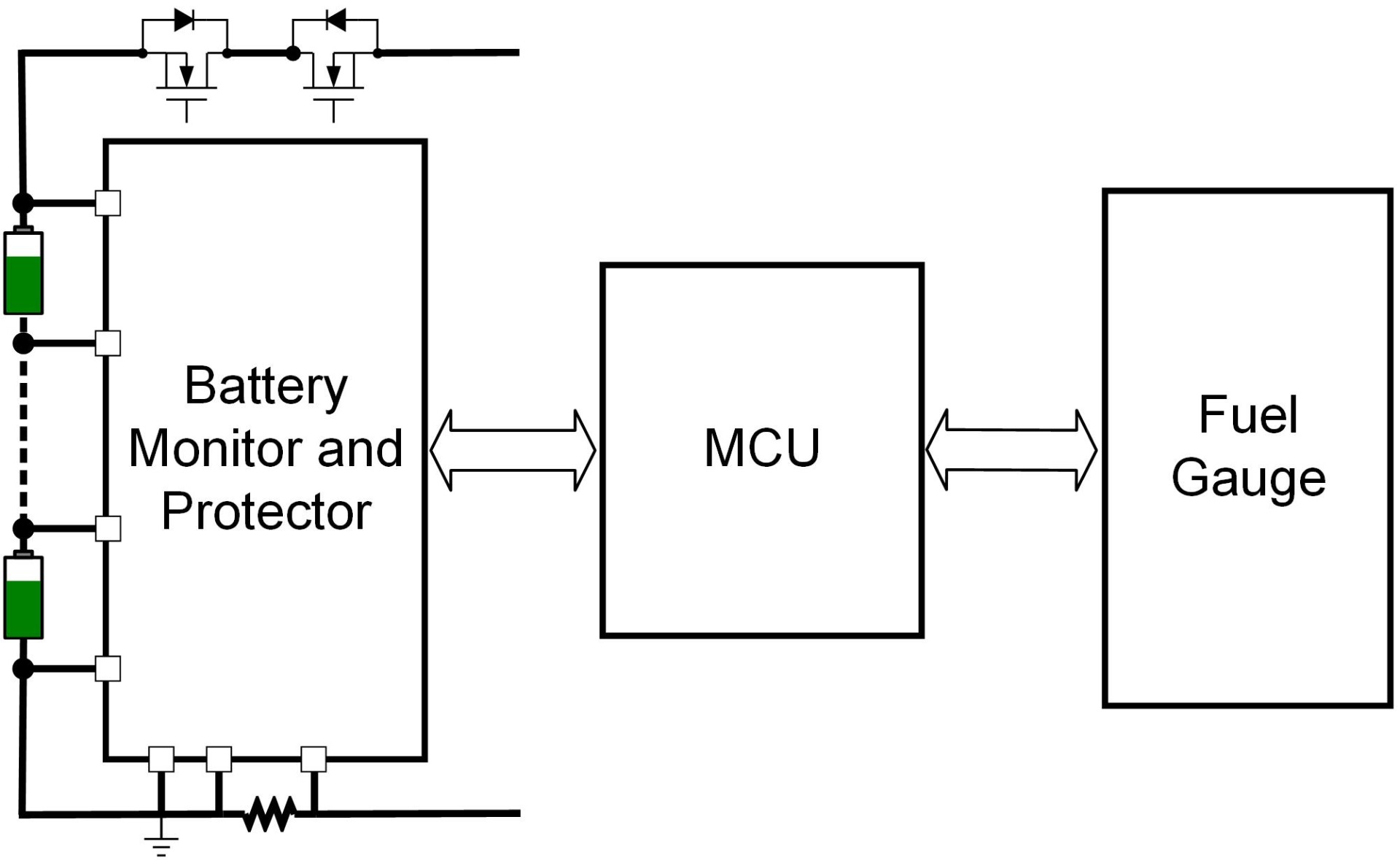
Figure 1: BMS Architecture
One of the most important parameters for a BMS is the accuracy of its state-of-charge (SOC) estimation. Errors in SOC estimation may lead to poor battery lifetime and runtime, as well as potentially dangerous situations, such as unexpected loss of power in the system.
Two main factors affect SOC accuracy: the battery monitor’s measurement accuracy, and the fuel gauge’s estimation accuracy. This article explores the impact of both factors on the final SOC estimation accuracy to establish design practices that will allow designers to better allocate resources when trying to optimize for SOC accuracy and cost.
Related Content
-
VIDEO
How to Accurately Measure Battery Pack SOC
Learn how MPS adopts a unique approach, combining a hybrid estimation method with an in-house cell model extraction process for superior SOC accuracy
-
ARTICLE
How to Design a Battery Management System (BMS)
Battery-powered applications have become commonplace over the last decade, and such devices require a certain level of protection to ensure safe usage
-
VIDEO

SOC vs. Analog Front End (AFE) Accuracy
This Tech Talk will provide a deep dive into fuel gauges, including traditional fuel gauge methods, SOC vs. analog front end (AFE) accuracy, how MPS fuel gauges improve safety and make calibration unnecessary, and more
-
WEBINAR
Key Considerations when Designing Battery Management Systems
This webinar discusses optimizing SoC accuracy and cost by examining the role of battery monitors & protectors, and fuel gauges
Fuel Gauge Algorithm Accuracy
The fuel gauge is the IC tasked with calculating the battery’s estimated SOC. Fuel gauge algorithms can be deployed in the main MCU, but a dedicated fuel gauge IC has many advantages, including:
- Efficiency: Fuel gauges reduce the MCU’s computation requirements, which makes the overall system more efficient.
- Reliability: A tried and tested fuel gauge IC improves all-around system robustness by enabling additional redundancies in the design, as well as ensuring a certain level of SOC accuracy.
- Fast time-to-market: Dedicated fuel gauges reduce engineering resource requirements due to their production-grade, fully validated algorithms that work for many cell types. It can take a team of software and battery engineers many months to years to develop a highly accurate fuel gauge algorithm.
There is no easy way to directly measure a battery’s SOC. Instead, the SOC must be estimated from the signals measured by the battery monitor. The fuel gauge’s accuracy depends on the method it uses to estimate SOC. The simplest method is Coulomb counting, which integrates the current going in and out of the battery, calculated with Equation (1):
$$SOC = SOC_{INITIAL} + \frac {∫I_{SENSE}}{Q} = SOC_{INITIAL} = \frac {∫I_{TRUE}}{Q} + \frac {∫I_{ERROR}}{Q}$$However, Coulomb counting is highly dependent on the initial SOC estimation, the current measurement accuracy, and the battery’s usable capacity. Moreover, inaccurate measurements are integrated, causing SOC estimation to drift over time. Thus, this method cannot guarantee convergence, which describes when the actual SOC matches the estimated SOC.
Rather than rely on just Coulomb counting, model-based methods can be used to consider current, voltage, and temperature readings to enable SOC convergence. These methods use mathematical cell models that correlate these readings to the estimated SOC. However, excessively imprecise voltage readings combined with low-fidelity models may incur a large SOC deviation error.
How Does the Battery Monitor (BM) Affect SOC Accuracy?
The battery monitor and protector is the IC responsible for sensing the battery’s voltage, current, and temperature. These measurements are then sent to the fuel gauge, which estimates the battery’s SOC based on these readings.
Since the battery monitor is the first step in the SOC estimation process, its measurement accuracy inevitably plays a role in the final SOC estimation error. In a legacy BMS, which relies heavily on Coulomb counting or simplistic cell models to estimate SOC, battery monitor measurement accuracy is the leading source of deviation in SOC estimation. This has driven battery pack designers to search for the most accurate cell voltage measurement capability. However, improving SOC estimation using precise fuel gauge algorithms is far more efficient at improving SOC accuracy than just increasing battery monitor voltage measurement accuracy.
Furthermore, current trends in battery pack designs are moving towards the use of combined battery monitor and protector (BMP) ICs. BMP ICs take advantage of the fact that the battery monitor is the closest element to the battery, and is therefore the first to detect potential faults and dangers. This means that BMP ICs can trigger protections without the intervention of the MCU, making battery systems much safer.
Although some designers select their battery monitor primarily based on accuracy, slight differences between the measured value and actual value pose little danger to the system. A small deviation will not damage the battery because it will not be significant enough to prevent a protection from being triggered.
Impact of BMS and Fuel Gauge on SOC Estimation Accuracy
Thus far, this article has described how SOC estimation accuracy is driven by the fuel gauge method and battery monitor accuracy. However, we still need to assess how different fuel gauge methods and BM accuracies impact SOC accuracy. Multiple simulations were run, combining different fuel gauge methods and BM accuracies, to determine their contribution to SOC error. Figure 3 and Figure 4 show the SOC error for these scenarios.
The different scenarios in Figures 3 and 4 consist of 10 complete charge/discharge cycles, with 15 minutes of relaxation in between and a 50% initial SOC. In all scenarios, the BM current measurement offset was 20mA. An ideal mathematical model was used to minimize the error due to model inaccuracy, meaning that the battery data is generated from the same model used by all fuel gauge methods. Three different fuel gauge methods were considered:
- Coulomb counting, which integrates the current going in and out of the battery. (Note that voltage is only used for SOC initialization.)
- Coulomb counting plus open-circuit voltage (OCV)-based corrections, which uses the Coulomb counting method during charge/discharge and makes SOC corrections during relaxation periods using the open-circuit voltage relationship.
- MPS’s hybrid method, which considers measurement and mathematical cell model uncertainty to achieve the short-term accuracy of Coulomb counting and the long-term convergence provided by the mathematical cell model.
Figure 3 shows the SOC error for a lithium nickel manganese cobalt oxide (NMC) chemistry cell.
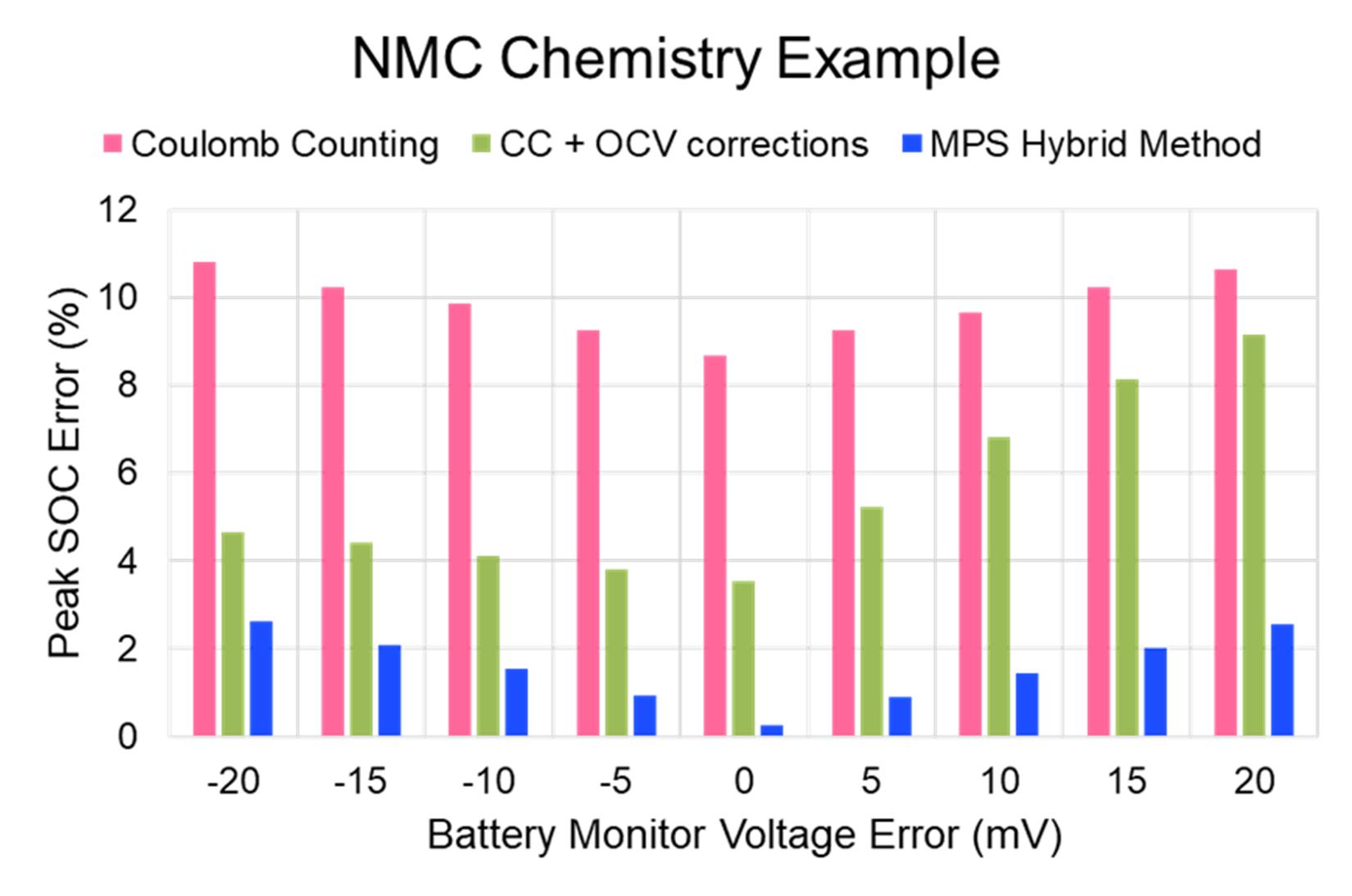
Figure 3: SOC Error (NMC Chemistry Example)
Figure 4 shows the SOC error for a lithium iron phosphate (LFP) chemistry cell. Note that LFP chemistry is more sensitive to voltage measurement inaccuracy because of its flat OCV.

Figure 4: SOC Error (LFP Chemistry Example)
The following can be observed from both Figure 3 and Figure 4:
- The Coulomb counting method provides the poorest results since it is unable to recover from inaccurate initial SOC due to the lack of feedback. Furthermore, any error in the current measurement causes the SOC to drift over time.
- Coulomb counting plus OCV-based corrections method helps reduce SOC drift over time, but also has some shortcomings. First, the corrections may be infrequent since they only occur during relaxation periods. Second, corrections cause SOC jumps that can create system-level problems and negatively affect the end customer. Any errors in the OCV model and cell voltage measurements will greatly impact this method.
- The MPS hybrid method applies small but continuous SOC corrections to ensure that the SOC estimate is smooth and tracks the true SOC. This is achieved by using voltage, current, and temperature measurements with a high-fidelity model. Furthermore, the algorithm optimally corrects the SOC based on current operating conditions and considers model/measurement inaccuracies. This limits the need for very high accuracy on any single parameter, such as cell voltage measurements.
It is important to note that as time passes, cell model parameters such as resistance and capacity change, which may affect SOC accuracy even in systems that use expensive, high-end battery monitors. This is why it is crucial to have an accurate fuel gauge that can calculate cell impedance by receiving synchronous voltage and current measurements from the battery monitor. Synchronous measurements are available in advanced battery monitors such as the MP279x family from MPS.
Solutions to SOC Estimation Errors
High-end fuel gauges such as MPS’s MPF4279x family, implement a hybrid estimation method that uses high-fidelity models, considers the uncertainty of the input measurements to reduce the impact of inaccurate sensing, and tracks the resistance rise and capacity fade of each individual cell connected in series in order to maintain high SOC estimation accuracy across the entire battery life cycle. The complete set of estimated parameters includes the battery’s power limits, state-of-health (SOH), runtime, and charge time.
Figure 5 shows how high-end fuel gauges like the MPF42791 can significantly improve SOC estimation results for a given BM measurement accuracy, becoming the key parameter to achieving excellent performance.
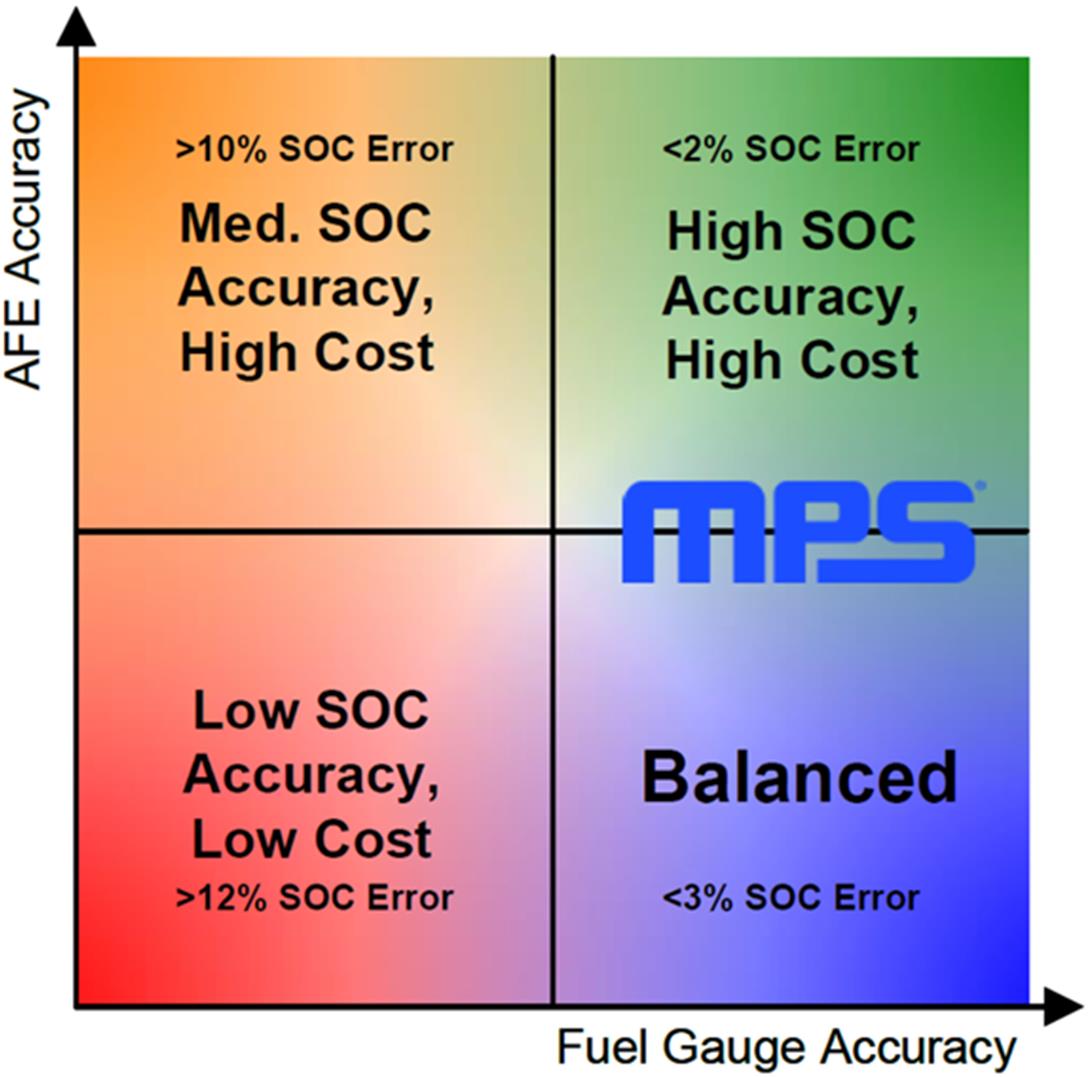
Figure 5: Improving SOC Estimation
Conclusion
In conclusion, accurate estimation of a battery’s SOC is key for any battery-powered application, and it is the BMS designers’ task to optimize the tradeoff between SOC accuracy and cost. Oftentimes, BMS systems target expensive battery monitors with extremely high voltage accuracy to achieve good SOC estimation accuracy. However, this adds unnecessary cost to the battery monitor for only marginal improvement; by contrast, high-end fuel gauges can achieve better SOC accuracy with lower total system cost and design time.
_______________________
Did you find this interesting? Get valuable resources straight to your inbox - sent out once per month!
Technical Forum
 Latest activity a day ago
 2 Comments
Latest activity a week ago
4 Comments
Latest activity 2 weeks ago
4 Comments
2 Comments
Latest activity a week ago
4 Comments
Latest activity 2 weeks ago
4 Comments
Log in to your account
Create New Account