


Simplifying the Power Supply Solution for Smart Meters with the MP5493


Get valuable resources straight to your inbox - sent out once per month
We value your privacy
Introduction
With recent trends toward digitization and informatization, smart meters that provide high precision, a wide range, and remote meter reading have become an indispensable part of the modern power grid and integrated in thousands of households. Smart meters must upload data in real time, and in the case of sudden power failure, a backup power supply is required to save the data and upload it to the server. Designing a backup power supply is therefore key to the smart meter power supply scheme.
Typically, smart meters use a supercapacitor as a backup power source. When the input voltage (VIN) is normal, the power supply system must convert VIN to the low voltage required to charge the supercapacitor. If an input loss is detected, the power supply system must use a boost converter to convert the low voltage across the supercapacitor to a high voltage that can power the input. The traditional power supply solution for smart meters more complex, using three chips: buck, low-dropout (LDO) (used to charge the supercapacitor), and boost.
This article explores a simplified power supply solution for smart meters using the MP5493.
Highly Integrated, Innovative Design
The MP5493 provides an innovative architecture that uses a single chip to achieve a backup power supply scheme. It includes two built-in converters. The first built-in converter is a buck step-down converter that reduces the bus voltage (VBUS) to the 3.3V or 5V level required by the meter. This provides power for the subsequent microcontroller unit (MCU), with a full 0.6A load current.
The second built-in converter can operate in buck or boost mode, depending on the circuit state. When VBUS remains normal, the converter operates in buck mode to reduce VBUS to the rated voltage of the supercapacitor for charging. If the bus shuts down and VBUS is below the set threshold, then the converter switches to boost mode to boost the supercapacitor voltage. This maintains VIN and ensures that the first output remains constant for a set period. The information collected by the meter can be uploaded without being lost.
Figure 1 compares the traditional solution for the smart meter power supply to the solution using the MP5493.
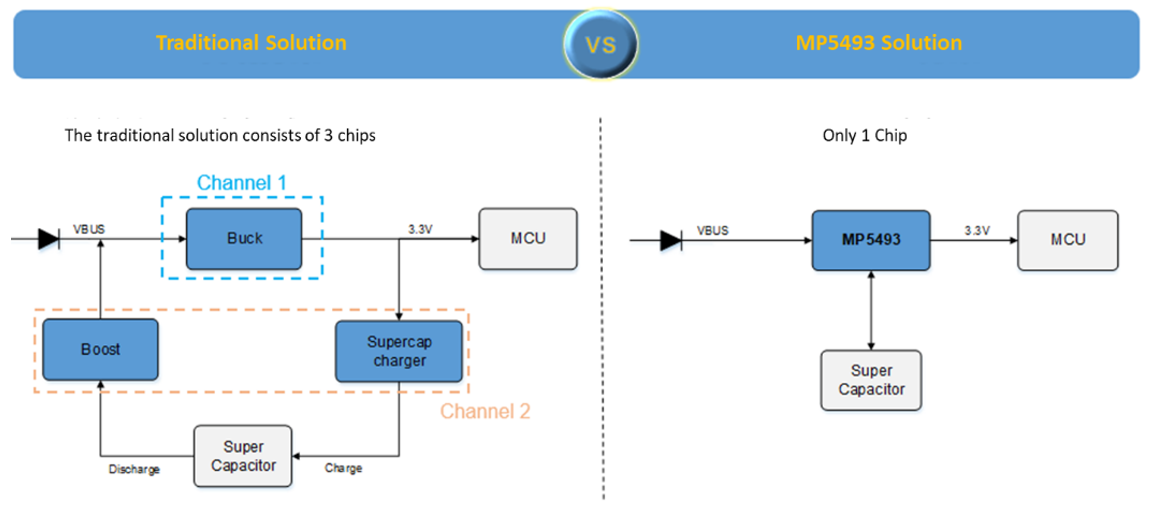
Figure 1: Traditional Power Supply Scheme vs. MP5493-Based Power Supply Scheme
Related Content
-
VIDEO
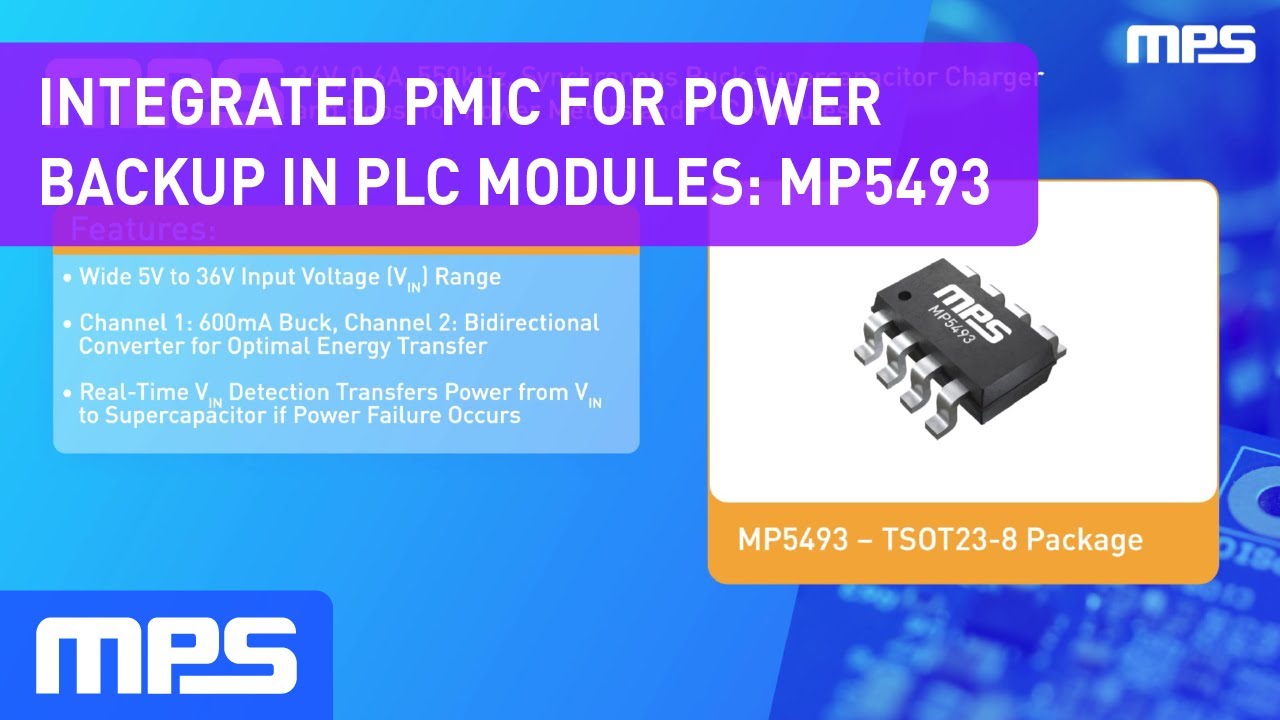
Integrated PMIC for Power Backup in PLC Modules: MP5493
Discover the MP5493, MPS's highly integrated 36V energy backup and management PMIC for PLC modules and power meters.
-
USE CASE

Power Management Use Case: Power Meters
This use case examines the application of the MP5493, MP5042, and MIE1W0505BGLVH in power meters.
-
APPLICATION BLOCK
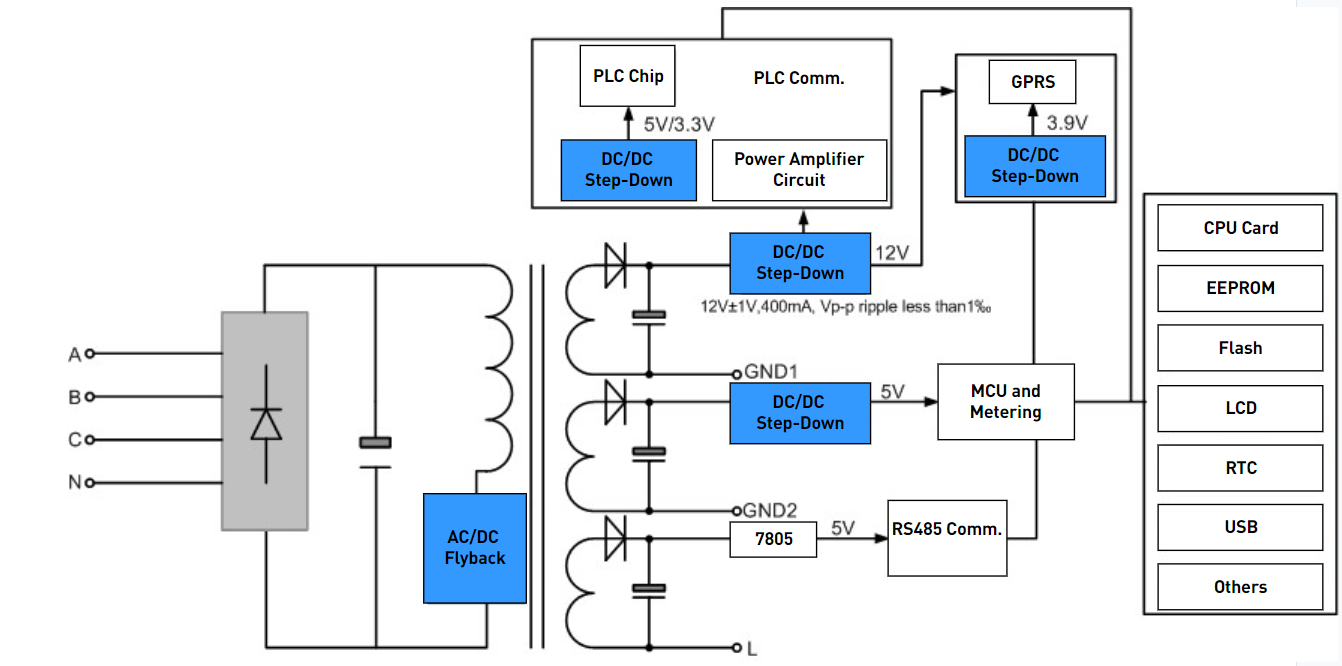
Three-Phase Smart Power Meters
MPS’s industry-leading solutions combine high efficiency and small package sizes, providing everything you need to design the next generation of three-phase smart power meters.
-
ARTICLE
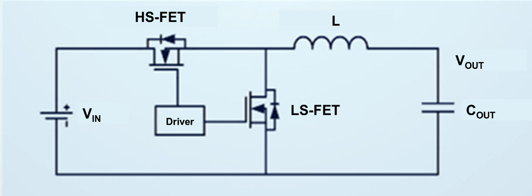
Optimizing Power Supply Efficiency with MOSFET Selection
This article discusses how to choose the ratio between the number of high-side MOSFETs (HS-FETs) and low-side MOSFETs (LS-FETs) to improve efficiency in power supply designs.
Ultra-Small Package for Cost Optimization
Due to its innovative architectural design combined with MPS’s advanced process technology, the MP5493 is available in an ultra-small TSOT23-8 package with a chip size that is only 3mmx3mm (see Figure 2).
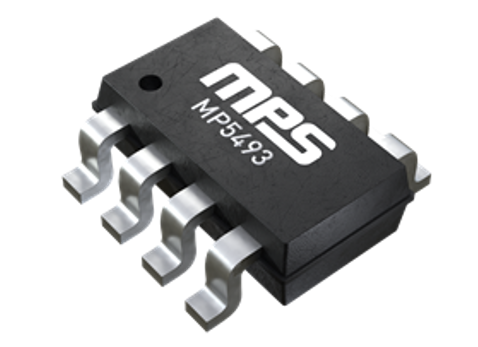
Figure 2: MP5493 3D Model
The peripheral device count is also minimized compared to traditional three-chip solutions, further reducing the circuit size and BOM cost. Cost optimization improves the overall cost-effectiveness of electricity meter products in the competitive market. Figure 3 shows the typical application circuit of the MP5493.
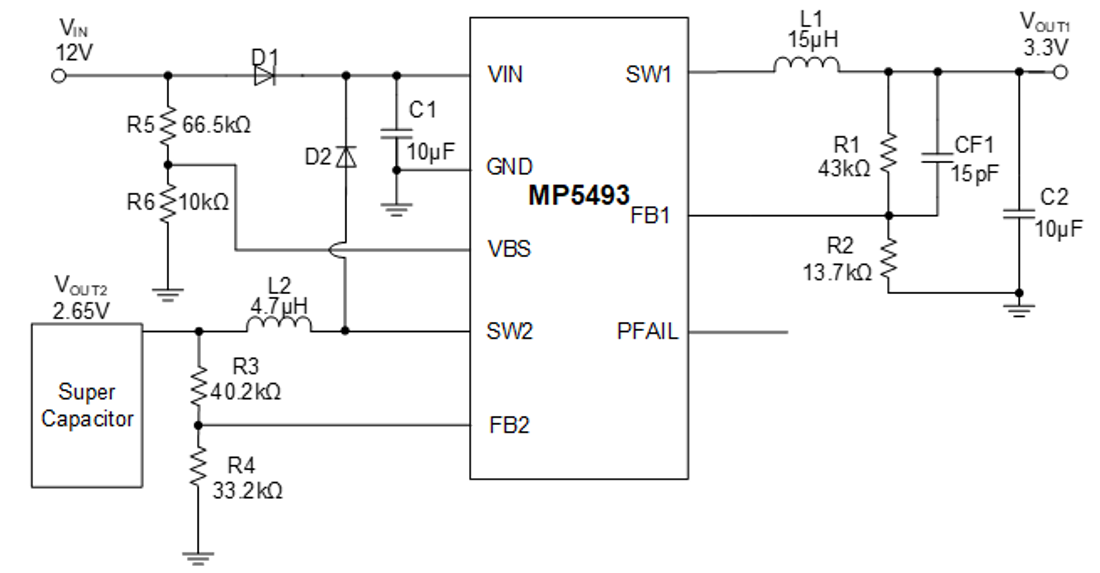
Figure 3: MP5493 Typical Application Circuit
Robust Features and Excellent Performance
The MP5493 provides a full range of protections, including over-current protection (OCP) with hiccup mode, output short-circuit protection (SCP), output over-voltage protection (OVP), and over-temperature protection (OTP). These protections ensure that the chip can operate in various conditions to avoid serious failures and improve the reliability of power supply systems and products.
Compared to traditional solutions, the output voltage (VOUT) of channel 2 in buck mode can be adjusted via an external resistor, which improves the flexibility of the power supply system. The MP5493 also integrates an input shutdown indication that outputs a signal to the back-level controller to help the system make a timely response when input power loss is detected.
In addition, the MP5493 achieves high energy conversion efficiency across the full load range by reducing the number of switching times at light loads and reducing the on resistance (RDS(ON)) of the built-in MOSFETs. Figure 4 shows that even if the inductor has a large DCR, the energy conversion efficiency of channel 1 can reach 88%, with a temperature rise at full load below 10K.
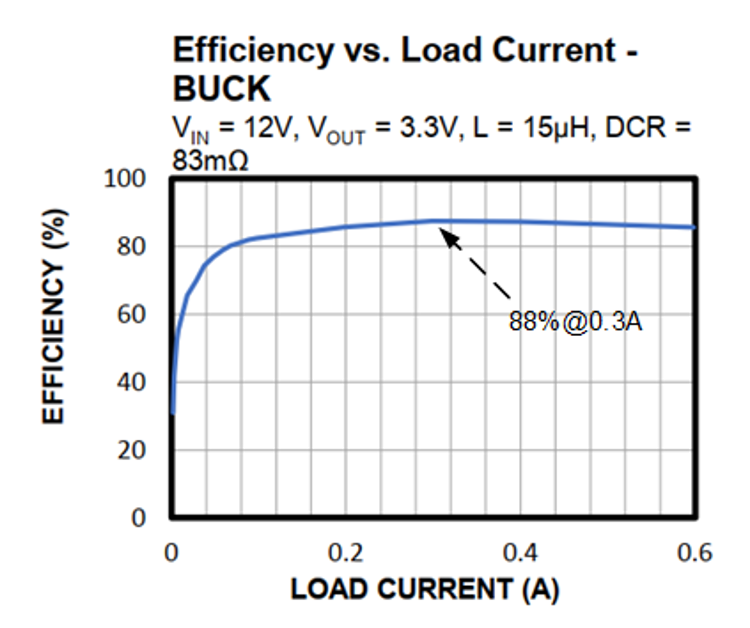
Figure 4: Typical Efficiency Curve of Channel 1
Figure 5 shows the waveform diagram of the cut-in process of the supercapacitor’s backup power supply once VIN is disabled. After VIN drops for about 2ms, the MP5493 detects that VIN is below the set threshold and begins to supply power from the supercapacitor boost. VOUT of channel 1 remains stable throughout the process and is not affected by power switching.
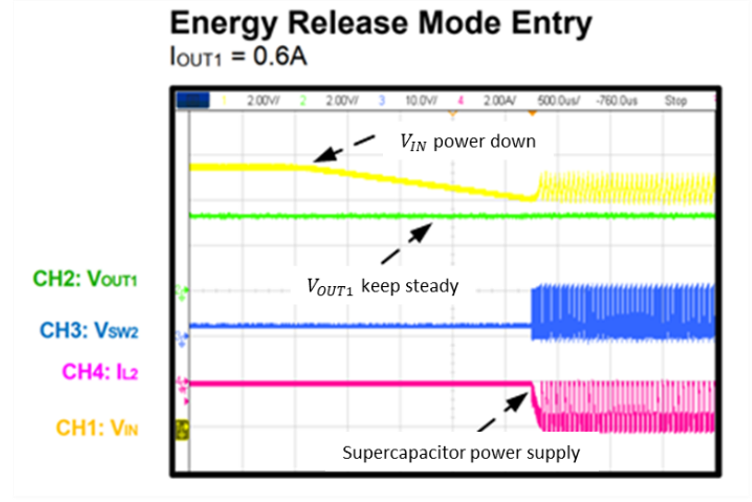
Figure 5: Channel 2 in Boost Mode Supplies Power to VIN
Conclusion
The MP5493 is an advanced energy backup and management unit that provides a highly integrated, low-cost, high-performance smart meter power supply solution with a small package and multiple functionalities. This solution can also be used in power-line carrier communication (PLCC) and other applications that require backup power.
Browse MPS’s complete selection of Power Management IC (PMIC) solutions.
_______________________
Did you find this interesting? Get valuable resources straight to your inbox - sent out once per month!
Technical Forum
 Latest activity 2 days ago
 4 Comments
Latest activity 3 days ago
6 Comments
Latest activity 4 days ago
7 Comments
4 Comments
Latest activity 3 days ago
6 Comments
Latest activity 4 days ago
7 Comments
Log in to your account
Create New Account