


LLC Transformer Driver Use Case: DC Fast-Charge Stations


Get valuable resources straight to your inbox - sent out once per month
We value your privacy
This use case examines the application of the MPQ18913 in DC fast-charge (DCFC) stations.

Figure 1: DC Fast-Charge Stations
The MPQ18913’s LLC resonant topology offers several key features, including a resonant LLC tank with a magnetizing inductor (LM) for energy transfer, as well as an additional capacitor (CR) and inductor that make the tank resonate at a certain frequency.
Flyback topology is typically used as the gate driver’s power supply for insulated-gate bipolar transistor (IGBTs) or silicon carbide (SiC) FETs. As the battery voltage (VBATT) in electric vehicles continues to scale up from 400V to above 800V, it has become more challenging to meet the isolation requirements of high-power charging systems such as DCFC stations while minimizing the interwinding capacitance in the design. LLC resonant topology is optimal for higher voltage systems because it allows for isolation voltages up to 5kV and minimizes interwinding capacitances down to 6pF or less with a resonant LLC tank.
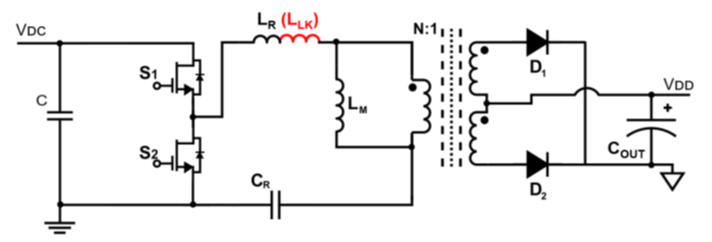
Figure 2: LLC Topology
The MPQ18913 is a high-frequency, half-bridge transformer driver that biases SiC FETs. The MPQ18913’s LLC resonant topology offers several key features, including a resonant LLC tank with a magnetizing inductor (LM) for energy transfer, as well as an additional capacitor (CR) and inductor that make the tank resonate at a certain frequency. The leakage inductance from the resonant inductor in the tank eliminates voltage spikes and improves efficiency compared to flyback topologies. As a result, the MPQ18913 can effectively meet the higher power requirements of DCFC stations.
A charging station system solution can be designed integrating the MPQ18913 and dual-channel isolated gate drivers. For signal isolation, MPS offers quad-channel digital isolators (MP27922, MP27931, and MP27940) as well as 6-channel digital isolators (MP27933, MP27942, and MP27960).
Additional features of the MPQ18913 include:
- High Performance:
- Configurable Switching Frequency (fSW), Up to 5MHz
- Automatic Resonant Frequency Detection during Start-Up
- Frequency Spread Spectrum (FSS) for Reduced EMI
- Supports Up to 6W of Output Power
- 5V to 30V Input Voltage (VIN) Range
- Robust Design for Automotive Environments:
- -40°C to +150°C Junction Temperature (TJ) Range
- Available in a Tiny QFN-10 (2mmx2.5mm) Package
- Available in a Wettable Flank Package to Enable Optical Inspection
- Available in AEC-Q100 Grade 1
For more information, explore MPS's family of isolated solutions for automotive applications.
Related Content
-
WEBINAR

Maximizing Power Density of DC Fast-Charging Systems with an LLC Power Supply
Learn more about single-channel/dual-channel isolated gate drivers, 4-channel to 6-channel digital isolators, and more.
-
ARTICLE
DC Fast Charging System: Maximizing Power Density with an LLC Transformer Driver
LLC resonant topologies reduce solution size, which increases power density for high-power charging stations such as those used for charging electric vehicles.
-
VIDEO

Isolated LLC Transformer Driver: MPQ18913
The MPQ18913 is a 30V, 6W, high-frequency, automotive LLC transformer driver for isolated bias power supplies.
-
ARTICLE
Understanding LLC Operation (Part I): Power Switches and Resonant Tank
LLC resonant converters have become a hot topic in power electronics because they can meet the demanding performance requirements set by modern power supply designs.
Log in to your account
Create New Account