


Improving a Video Doorbell with a Power Management IC and Motor Driver


Get valuable resources straight to your inbox - sent out once per month
We value your privacy
Introduction
The Internet of Things (IoT) describes devices that connect to then exchange data between devices and systems over the Internet (or occasionally communication networks). IoT applications have revolutionized how we can interact with the world around us, particularly with our home devices. The video doorbell is one example; these doorbells provide real-time videos, audio functionality, and even peace of mind for the end user.
However, there are issues faced by IoT devices like video doorbells that impact reliability and performance. This article will discuss a few of these challenges, and will introduce how the MP5413, an power management IC (PMIC), and the MP6515, an H-bridge motor driver, improve these applications.
Challenges Faced with Video Doorbells
Video doorbells are part of the modern smart home (see Figure 1). These doorbells are constantly connected to the internet and a power source, and are able to send updates and alerts to the homeowner when motion is detected or when the doorbell is rung. They can even be paired with smartphones so that users can access and record the camera’s feed from anywhere, whether at a local restaurant, while at home, or on vacation.

Figure 1: Video Doorbell
IoT video doorbells must be small enough to fit in different home/doorway configurations, in addition to demanding sufficient power to record and transmit videos. Depending on whether a fixed power source is available, some of these doorbells are powered by batteries, which means that a high power demand can quickly drain the battery and leave the doorbell nonfunctional if the battery is not recharged or replaced. Other issues include that battery replacements lead to unnecessary e-waste and may be expensive.
In addition to concerns regarding power management, cameras may need to rotate, pivot, and move as needed by the homeowner. An ambulatory camera allows homeowners to observe a greater area than a stationary camera can provide, empowering the homeowner with the ability to see further into their yard or see other parts of their porch.
Related Content
-
APPLICATION

Video Doorbells
MPS’s highly flexible, cost-effective solutions offer everything you need to power the next generation of video doorbells.
-
ARTICLE

Using Current Regulation in DC Motor Drivers
This article discusses using the current regulation function integrated into many motor driver ICs, while using examples from Monolithic Power Systems (MPS) to address high-current conditions.
-
USE CASE
Power Management IC and Step-Down Converter Use Case: Wi-Fi 6/7 Routers and Access Points
This use case examines the application of the MP5496 and MP8770C in Wi-Fi 6/7 routers and access points.
-
VIDEO
Precise Motion and Position Control for BLDC Motors
MPS Smart Motor Modules can be easily adapted to customize or upgrade third-party brushless DC motors.
How a PMIC Improves Video Doorbells
Smart doorbells must be able to balance their constant connectivity and their need to conserve power. If a doorbell does not have an adequate PMIC, it may require frequent charges, which can leave homeowners vulnerable in the event of a security breach, or when the homeowner is expecting company.
For a video doorbell solution that utilizes IoT, an ideal PMIC would be able to consume as little power as possible while ensuring the doorbell has full functionality. This device would need to be tiny, reliable, and could benefit from configurability to meet different system specifications.
The MP5413 is a PMIC with ultra-low power consumption. It integrates four high-efficiency, step-down DC/DC converters, two low-dropout (LDO) regulators, and two controllable GPO ports.
The device provides configurable on/off sequencing to control when the device turns on and off for maximized power sequencing. Being able to fine-tune the MP5413’s on/off state enables the overall system to better regulate power consumption and extend battery life. It also features sleep mode control to protect battery life when the part is not actively needed for operation.
Because it is highly integrated, the MP5413 reduces external component count, and its default 1.5MHz default switching frequency (fSW) in continuous conduction mode (CCM) reduces the number of required inductors and capacitors.
To prevent damaging the system, the MP5413 features robust protections, including thermal shutdown to avoid overheating, over-current protection (OCP) to prevent device and system damage from high currents, and under-voltage lockout (UVLO) to ensure that the MP5413 only operates when there is sufficient input voltage. The MP5413 is available in a WLCSP-38 (2.7mmx3.1mm) package.
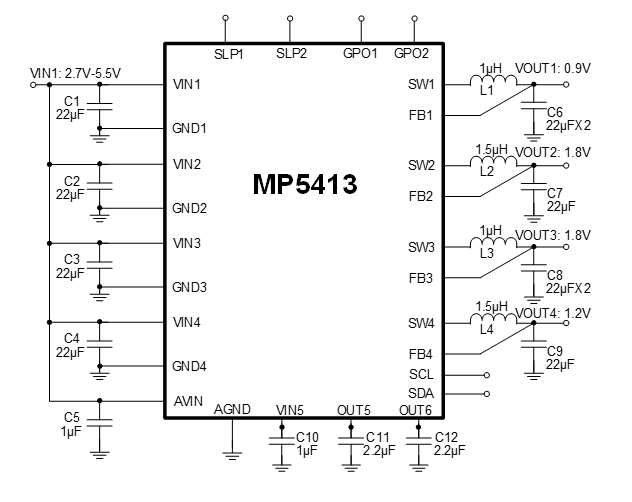
Figure 2: MP5413 Typical Application Circuit
How a Motor Driver Improves Video Doorbells
A motor driver for an IoT video doorbell should be able to guarantee a spectrum of motion while ensuring accurate video capture. This driver would need to intelligently reduce its power consumption when idle, but be capable of waking up quickly to avoid missing out on critical use.
Motor drivers can also be programmed for certain actions, such as becoming active (and staying active) when a walking person is in view. If there is an issue with this feature, it can result in unreliable operation and potential safety concerns (e.g. not having video capture of a package theft).
The MP6515 is a high-performance H-bridge motor driver designed to drive brushed DC motors. The driver has simple logic interfaces (PHASE, ENBL, BRAKE, and BMODE) to control aspects such as the brake input and mode, motor direction, and the enable function.
Similar to the MP5413, the MP6515 provides robust protections such as OCP, UVLO, and thermal shutdown. In addition, the device’s blanking time ensures that the device does not accidentally turn off due to the potential current spike during start-up, safeguarding continuous operation.
Because motor drivers increase the application’s power demand, it is critical that they be able to reduce their power consumption. The MP6515 has an nSLEEP pin that can put the device into a sleep state to further reduce power consumption and extend battery life. In sleep mode, the internal circuits (e.g. gate driver charge pump, H-bridge outputs) are turned off, and all inputs are ignored. It only takes 1ms for the device to wake up from sleep mode, which allows the video doorbell to achieve motor driver functionality faster than the blink of an eye.
The MP6515 can provide precise motor control for camera accuracy, and its cycle-by-cycle current regulation reduces power consumption during operation. It is available in a QFN-16 (3mmx4mm) package or a thermally enhanced TSSOP-EP (5mmx6.4mm) package. Figure 3 shows the MP6515’s typical application circuit.
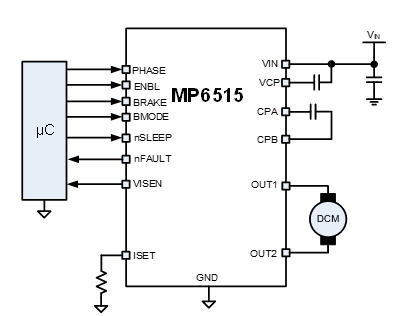
Figure 3: MP6515 Typical Application Circuit
Conclusion
Video doorbells can harness the power of IoT so that homeowners can be aware of and alerted to a wide range of events on their own doorsteps, regardless of where they are. These doorbells can provide clear images that enhance convenience and security for the end user. However, video doorbells can consume a significant amount of power, which makes PMICs such as the MP5413 one of the key concerns for these applications. Many video doorbells also demand high resolution and quick activation, which requires a motor driver — such as the MP6515 — that can wake up quickly.
MPS features power management ICs and motor drivers that can be utilized in video doorbell applications. These devices are incredibly compact and highly efficient. For our full range of power management ICs and motor drivers, visit the MPS website.
_______________________
Did you find this interesting? Get valuable resources straight to your inbox - sent out once per month!
Technical Forum
 Latest activity 2 days ago
 7 Comments
Latest activity 5 days ago
4 Comments
Latest activity 6 days ago
6 Comments
7 Comments
Latest activity 5 days ago
4 Comments
Latest activity 6 days ago
6 Comments
Log in to your account
Create New Account