


Why Standalone ADCs Still Matter: Precision, Flexibility, and Simplicity in Modern Embedded Systems


Get valuable resources straight to your inbox - sent out once per month
We value your privacy
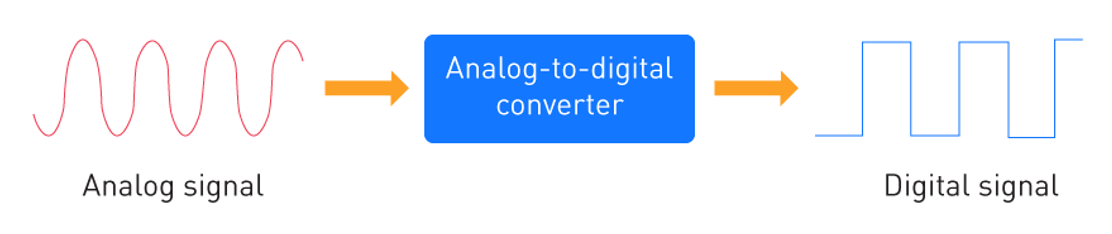
In a world where microcontrollers (MCUs) often come equipped with integrated analog-to-digital converters (ADCs), it may seem like the need for standalone ADCs is fading. But for system designers working on industrial, instrumentation, and embedded applications, standalone ADCs remain an essential building block by offering advantages in performance, layout flexibility, and design simplicity that integrated solutions cannot always match.
The Case for Standalone ADCs
Many embedded systems must monitor real-world signals, such as voltages, currents, temperatures, and the outputs of analog sensors. While integrated ADCs can handle basic tasks, they may fall short when designs demand the following:
- Better signal fidelity
- Direct conversion control
- Additional ADC channels
- Closer sensor placement and layout optimization
Standalone ADCs can address these needs by providing decreased digital noise coupling, dedicated pins for conversion control, and flexible component placement, as described in greater detail below.
Noise Isolation and Signal Accuracy
A major drawback of integrated ADCs is their proximity to noisy digital circuits inside an MCU. The internal coupling of substrate noise or power supply interference can degrade the accuracy of sensitive analog measurements. A discrete ADC that is physically placed near the signal source reduces the potential for noise contamination. This is especially critical in high-precision, low-signal, or harsh environments, such as industrial process control and data acquisition.


Direct Control and More Channels
External ADCs allow designers to choose the resolution, speed, and architecture best suited for the signal being measured. They also typically provide direct timing control for each conversion. External ADCs can be used to easily expand the number of available ADC channels without requiring a more complex or expensive microcontroller. This is especially helpful in late-stage designs, when additional monitoring points are needed but board space and redesign time are limited.
Flexible Placement for Optimal Performance
In many applications that monitor board health, the analog signal source (such as a current shunt, temperature sensor, or voltage rail) is not located near the system’s MCU. Routing low-level analog signals across the board to a central MCU can introduce noise and reduce measurement accuracy. A small, standalone ADC can be placed right next to the signal source. This ADC allows the analog trace to remain short, while digital data travels across the board to the processor with far less vulnerability to noise.
Simplified Design Choices
Using standalone ADCs can also simplify overall system design. Standalone ADCs can feature enhanced performance, integrated voltage reference, a configurable gain amplifier, buffer, transimpedance amplifier, excitation sources, or a temperature sensor that is better matched to the requirements of the analog signal being measured. Many of these ADCs offer built-in voltage references, front-end signal conditioning, serial peripheral interface (SPI) or I2C digital interfaces, and minimal configuration requirements. Designers can select an ADC that matches the exact needs of the application.
A Real-World Example: The MDC97476/7/8 ADC Family
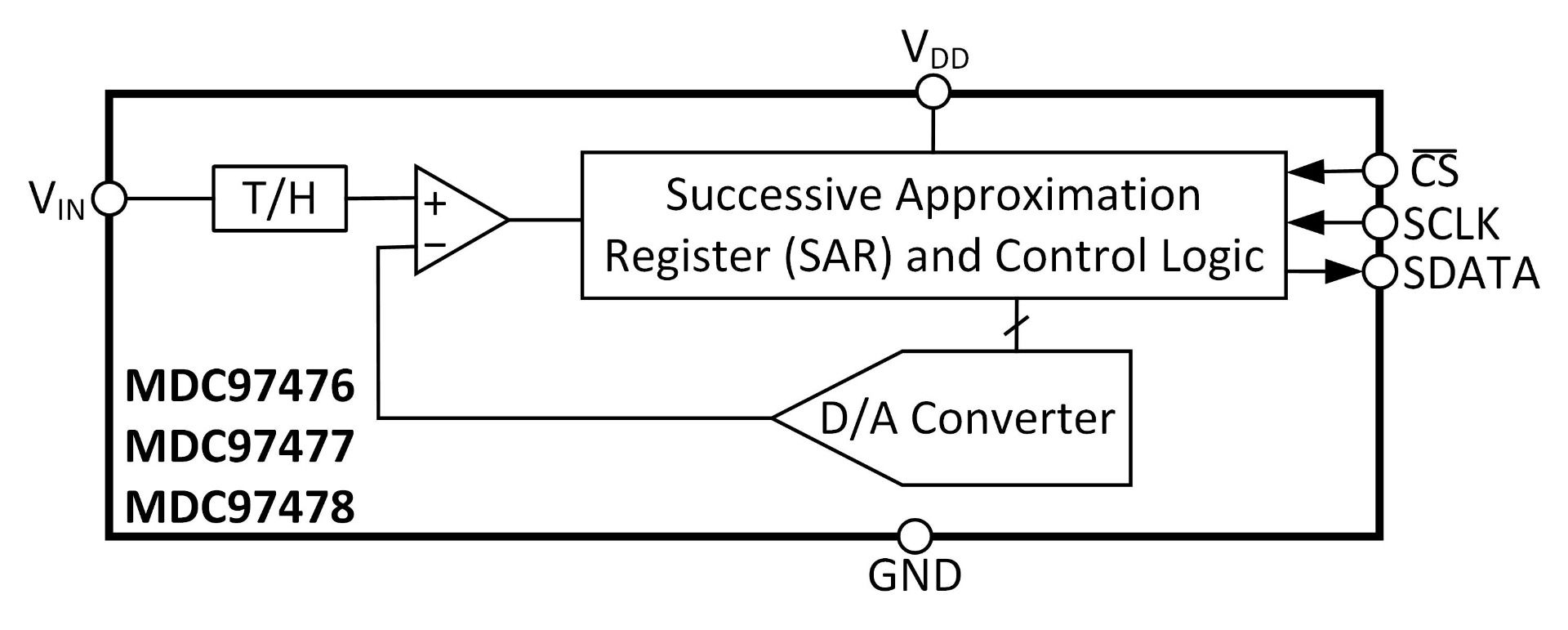
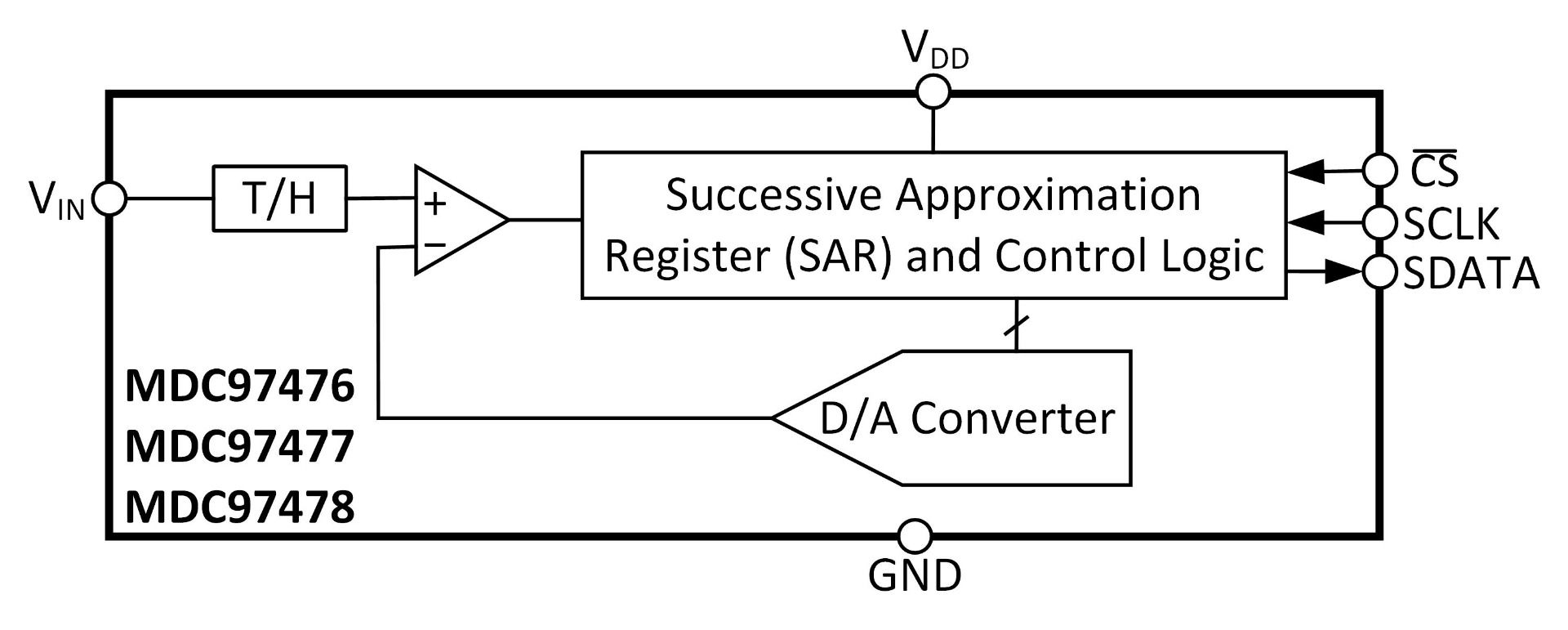
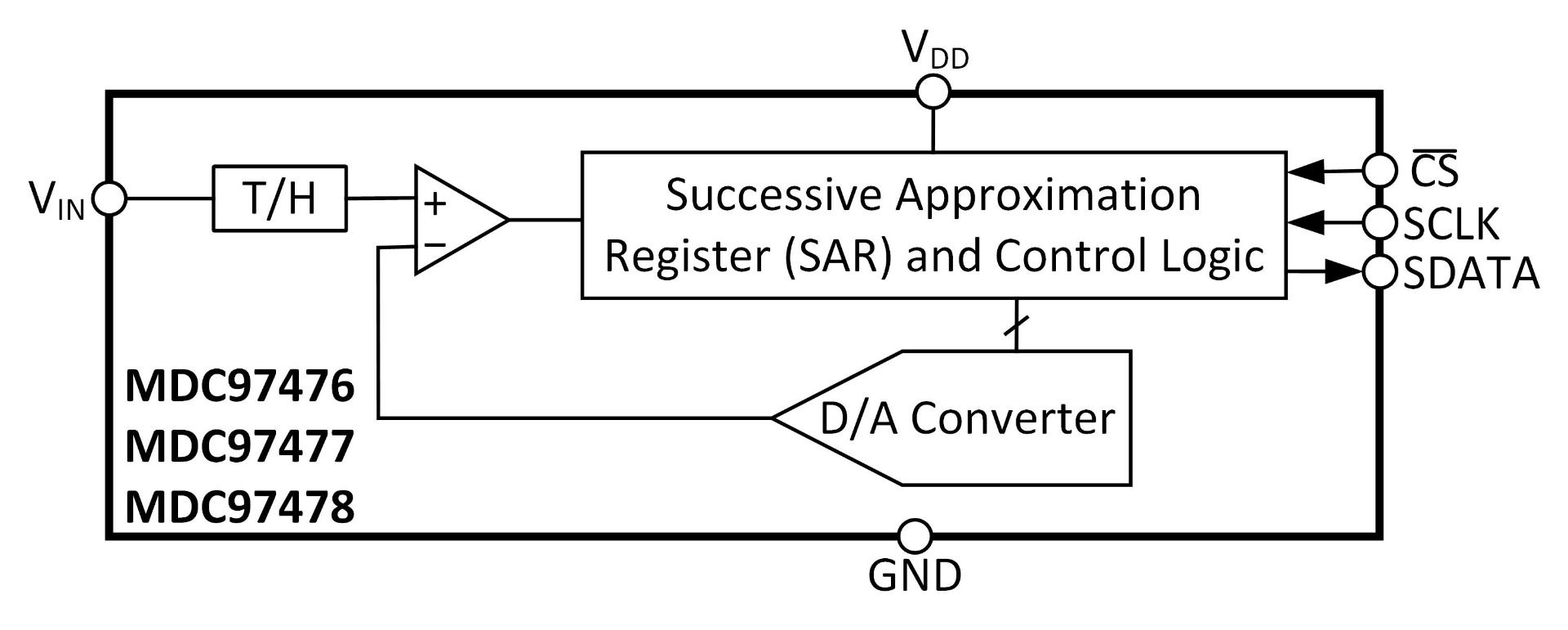
The MDC97476/7/8 family from MPS — which consists of the MDC97476, MDC97477, and MDC97478 — embodies the advantages of standalone ADCs. These 12-bit, 10-bit, and 8-bit successive-approximation register (SAR) ADCs offer conversion speeds up to 1Msps, with low power consumption (as low as 4.9mW at full speed). In addition, they are housed in a compact, 6-lead TSOT-23 package.
Key Features
- Resolution: 12-Bit (MDC97476), 10-Bit (MDC97477), 8-Bit (MDC97478)
- Speed: Up to 1Msps
- Signal-to-Noise Ratio (SNR): Up to 72dB (LTC7476 at 120kHz Input)
- Power Supply: Single 3V to 3.6V Operation
- Interface: Simple 3-Wire, SPI-Compatible Digital Output
- Reference: Derived from VDD— No External Reference Needed
- -40°C to +85°C Operating Temperature Range
With no registers to configure and a simple, read-only digital interface, the MDC9747x family is ideal for applications requiring fast, accurate conversions and minimal software overhead. The small footprint allows for placement close to the analog source, maximizing SNR and simplifying layout.
Whether you’re building an industrial sensor hub, a power monitoring solution, or a control loop that requires real-time data, these ADCs are designed to be easily dropped into applications and perform reliably and accurately. Figure 1 shows the typical application circuit for the MDC97476.
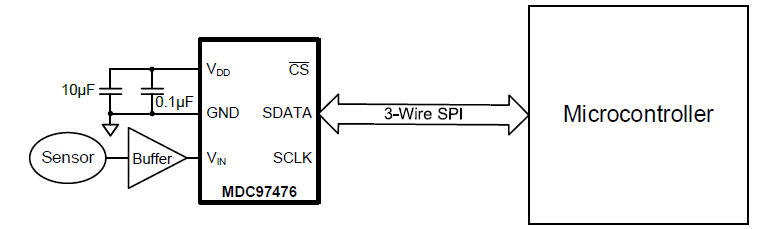
Figure 1: MDC97476 Typical Application
Conclusion
As embedded systems grow in complexity and demand greater performance, standalone ADCs remain a critical tool for designers. They offer a combination of accuracy, flexibility, and integration that complements MCU-integrated ADCs. Explore MPS’s SAR ADCs to determine whether the MDC97476, MDC97477, or MDC97478 best suits your application needs.
_______________________
Did you find this interesting? Get valuable resources straight to your inbox - sent out once per month!
Technical Forum
 Latest activity 2 months ago
 2 Comments
Latest activity 4 months ago
3 Comments
Latest activity 4 months ago
2 Comments
2 Comments
Latest activity 4 months ago
3 Comments
Latest activity 4 months ago
2 Comments
Log in to your account
Create New Account